
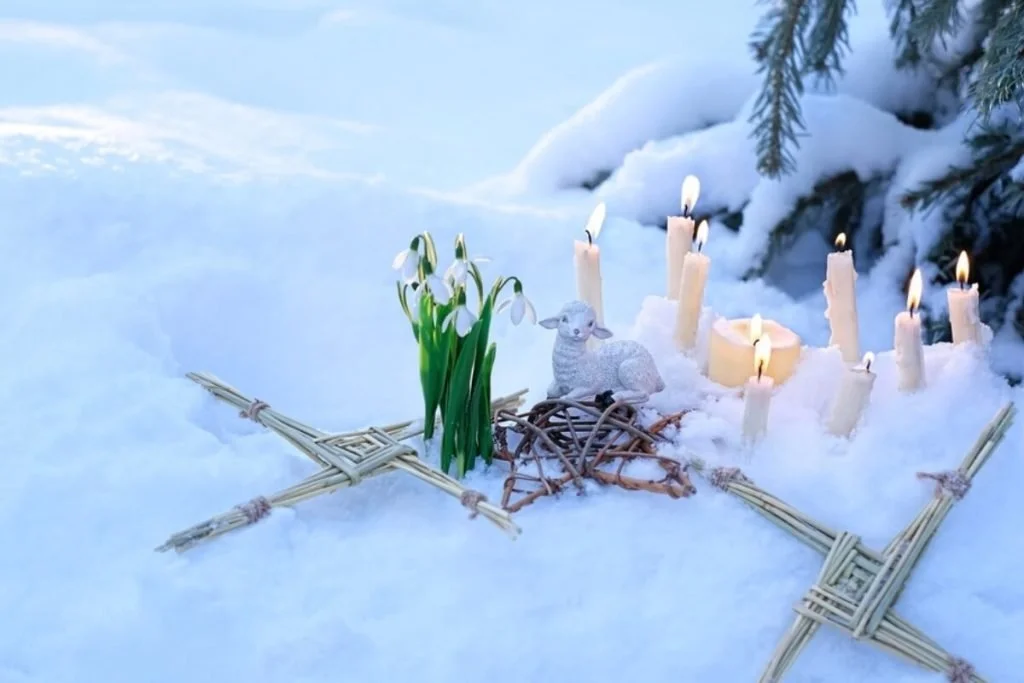
Celebrating Imbolc
Imbolc is an ancient seasonal festival rooted in the pre-Christian cultures of Ireland and the wider Celtic world.
Celebrated around February 1st or 2nd, Imbolc marks the midpoint between the Winter Solstice and the Spring Equinox. Though winter still dominates the landscape, Imbolc signifies the subtle but undeniable return of light and life. It is a threshold moment—a pause between the deep darkness of winter and the visible awakening of spring—honoring what is beginning to stir beneath the surface.
The earliest references to Imbolc appear in medieval Irish texts, where it is listed alongside other key seasonal festivals such as Beltane, Lughnasadh, and Samhain.
These festivals were closely tied to agricultural cycles and pastoral life. Imbolc, in particular, was associated with the lambing season, when ewes began to produce milk. This was a vital sign of survival and continuity after winter scarcity. The name “Imbolc” is commonly believed to derive from Old Irish words meaning “in the belly” or “ewe’s milk,” both pointing to gestation, nourishment, and promise rather than full fruition.
Central to Imbolc is the figure of Brigid, one of the most beloved goddesses of the Celtic pantheon.
Brigid was revered as a goddess of fire, fertility, healing, poetry, and smithcraft. She embodied both the hearth flame that warmed the home and the sacred flame of inspiration and transformation. When Christianity spread through Ireland, Brigid’s importance did not fade; instead, she was absorbed into Christian tradition as Saint Brigid of Kildare. This blending preserved many Imbolc customs, such as lighting candles, blessing homes, and honoring sacred wells, allowing the festival’s essence to survive through changing religious landscapes.
Fire and light are key symbols of Imbolc.
Unlike the blazing fires of midsummer, Imbolc’s flame is small, steady, and intentional. It represents hope, inspiration, and the growing strength of the sun. As days slowly lengthen, lighting candles at Imbolc serves as both a practical and spiritual act—acknowledging that even the faintest increase in light can shift the balance between despair and renewal. This symbolism resonates deeply in northern climates, where winter’s grip can feel unrelenting.
Imbolc is also a festival of purification and preparation.
Historically, this was a time for cleaning homes, repairing tools, and blessing seeds in anticipation of spring planting. On a spiritual level, these practices reflect the desire to clear away stagnation and make space for new growth. Water rituals, cleansing fires, and blessings were common, reinforcing Imbolc’s role as a liminal moment of transition.
In modern Pagan and Wiccan traditions, Imbolc remains a powerful Sabbat within the Wheel of the Year.
It is understood not as a time of outward action, but of inner alignment. The earth is still resting, yet life is undeniably present beneath the frozen ground. This mirrors the human experience of insight, intention, and quiet resolve forming before visible change occurs. Imbolc teaches patience and trust in unseen processes.
The deeper meaning of Imbolc lies in its honoring of beginnings that are fragile and easily overlooked.
It reminds us that transformation does not arrive all at once, but through small, consistent shifts. By acknowledging the sacredness of early stages—ideas, hopes, healing, and renewal—Imbolc offers a way to live in harmony with natural cycles. It is a celebration of faith in what is becoming, a recognition that even in winter’s cold, the promise of spring is already alive.
